So I was wondering how many people are blowing glass sustainably or using sustainable techniques and was amazed at how few people are bothering in the UK.
Most were recycling waste glass, called cullet, as we did since we opened our doors in 1998. At that point I think most studios with furnaces melted Dartington Crystal or Edinburgh Crystal’s 24% lead crystal cullet. It meant we could work a softer glass, with a longer working life without the problems of melting lead batch. We recycled our clear waste and even our coloured waste which turns blue. By segregating all the colours I found that the only colours formed are from green and blue glasses if they are segregated.
There was someone who’d changed to electric furnace powered by solar panels. That furnace is still using power when the workforce had gone home, so 16 hours burning with no productivity. Another used methane gas from a bio pod, powered by household and farm organic waste. A good way to power a furnace, if it’s turned off after each daily use.
Then there was some using a bench torch and lamp working, using propane and oxygen cylinders. Bead work and borosilicate scientific glass blowers have used this method for a few centuries. Although they were probably powered using whale oil and soft glass in the beginning.
I think any way you can reduce your CO2 emissions can only be a good thing. Having a gas powered glass melting furnace burning for the 19 hours that we wearn’t working it was troubling until I came up with a new way to blow “furnace glass”. We started by turning the furnace off part time and reduced our CO2 from 98 tons per year to about 57 tons. It was while off, one of our customers urgently needed some tumblers…After thinking about it we said it may be possible. They were made and sent off the following day. That got me thinking…What else could we make like this? We didn’t have to wait long, another customer asked for one of our small Incalmo flat bowls, made from two different incalmo cups. Again a bit of thinking had us making the incalmo sections, joining them and adding a foot.
From there we turned our glass melting furnace off, and it remains off after nearly 4 years. Our yearly CO2 output was 4.1, 3.7 and 3.4 tons per year which is probably about as low as it will get.
From those early days we’ve managed to make many of our ranges, even some of the big pieces, but it is far easier to make glass art than some production. We are still learning, it’s a different way of working, and far healthier in the summers heat. I can spend more time on the preparation work, which was beginning to take up a lot of time. We make all our cane, millefiori, reticello, zanfirico and merletto without using the glass melting furnace, it took a bit of figuring it out but we managed. Now it’s an every day occurrence…If we want to work the glass that is.
Anyway, here’s a few pieces we’ve made, and that includes all the preparation work…All without the glass melting furnace being on.
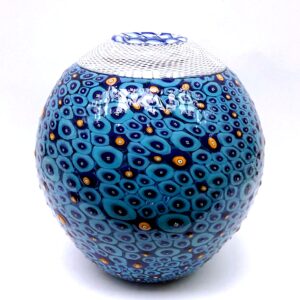
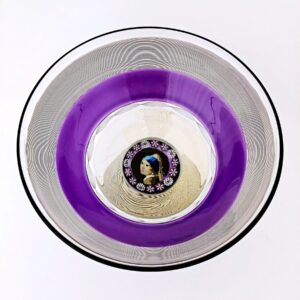
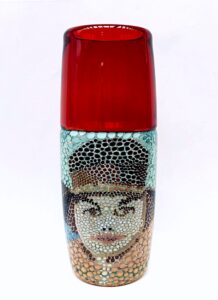
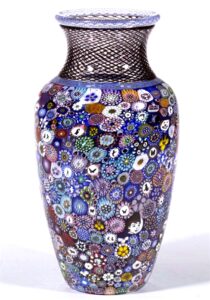
Reticello incalmo, with torsade rings, and one of every lead based
murrine I’ve made at Twists Studio Glass. 2022.