If glassblowing is one of the most energy intensive crafts on Earth…Read on.
Traditional institutions may guard the archives of the past, but Twists Glass perhaps hold a blueprint for the future for glassblowing, and maybe help the planet.
For 400 hundred years British glassmaking has bowed to a single, devastating reality, the immense, unyielding energy pull of the glass melting furnace. Originally furnaces were powered by wood, until forests started to dwindle and they were forced to move on. Then when coal powered, furnaces were set up closer to mining areas. Later, natural, and propane gas allowed factories and studios to set up wherever they had a supply. All of these fuels release high levels of CO2.
This establishment always accepted producing carbon emissions as the price for making glass objects.
Michael James Hunter did not!
Michael is the leading pioneer of recycle, reuse, and remake, carbon reduction, plus waste energy elimination in the UK’s British studio glass movement, making him a power house, market disruptor.
At Twists Studio Glass, Mike has staged a quiet revolution…
As the leading pioneer of carbon reduction in the studio glass movement since 1998, he has successfully decoupled elite luxury, from potential planetary destruction. By simply engineering an aggressive, zero energy waste, recycle reuse, and remake work flow. He has dramatically slashed furnace emissions, effectively taking eliminating energy wastage to new heights.
True luxury doesn’t allow the earth to pay for its beauty, so welcome to a new era. The blueprint for budding glass blowing artists to dramatically cut setting up, and energy costs for their glassblowing studio.
Initially it was all about recycling, then in 2010, Mike started his journey for the fight to lower the carbon burden of his studio glass workshop, an idea that originally formed in 2006!
The power house research, that he did on his own, absolutely cracked this carbon reduction problem through wasted energy that glass making studio makers still face today.
He has lowered his CO2 E from 98 tons from Natural gas per year to 3.4 tons from July 2024-to July 2025. The two previous years figures were 3.7 tons 23-24, and 4.1 tons in 22-23.
He innovates in isolation within the confines of his studio, while the establishment refuses to recognise the potential that working without using a glass melting furnace (that wastes around 16 hours of power while not being worked) just for the convenience of having molten glass to use the following day.
Working only 8 hours from a glass melting furnace means the following 16 hours turns into a massive 5840 hours of wasted energy in one year. Just think about that figure…5840 hours of wasted energy per year!
Mikes working policies means nothing is wasted when it comes to energy. They make what they need, and turn everything off, the only power being used is from the kiln finishing it’s annealing cycle.
Using innovative working methods, he’s continuing to make art to museum quality, with each piece having a low carbon footprint, rather than churning out production to pay expensive energy bills caused from a glass melting furnace on 24/7 365.
So when creating one of his picture cane murrine, which takes around 16-20 days, after all the cane has been pulled, the only power he is using is from the studio lighting.
It’s the same for any preparation work he’s doing, there’s no wasted power.
Twists Glass Studio won a prestigious VIBES award in 2004 for caring for the environment. This was way before any governmental directives on this matter, and historically places him at the forefront of sustainability within the glass studio movement in the UK.
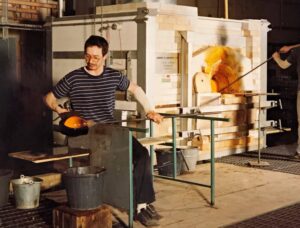
Mike, head of hot side, at the Crystal Company of Wales, around 1988. Are energy wasting glass melting furnaces a thing of the past?