So it was suggested that I prove our timeline for Twists Glass Studio’s care for the environment, so here goes!
I’ve been used to waste for most of my life while working in factories. There’d be tons of glass waste generated every working day from the 9 furnaces holding crucibles that could each hold 500lb of molten glass.
So it was no surprise that when I switched to studio work most of the artists melted waste cullet from one of the large factories. Obviously that had to be compatible with the coloured glass they were using!
When we opened Twists, we implemented strategies that would not only allow us to melt waste factory cullet, but to melt our own clear waste by segregating it from coloured waste, plus other recycling like packaging materials. Our wrapping “paper” is actually from large rolls of tea bag paper that was contaminated in some way, but ok for wrapping glass in.
The coloured waste I found melted together forming a mid blue glass. I then segregating colours to see what glass was gained, hoping for that colour to remain. Through a series of experimental melts I found that most turned a green or grey tint of clear, with the colour virtually gone from all types of glasses including opal colours. The only colours that remained was from green, and colours that contained cobalt. So as some of our purples contained a small amount of cobalt, a pale blue glass was gained.
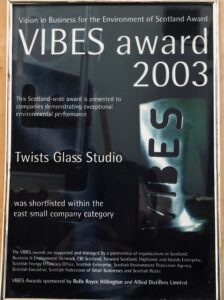
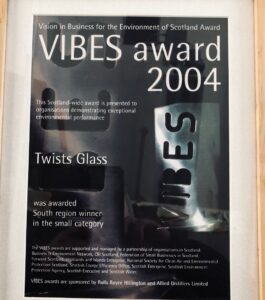
With other recycling policies we used we were shortlisted for a VIBES Award (Vision in Business for the Environment of Scotland Award). That was in 2003. In 2004 we was awarded South Region Winner in the Small Business Category.
In 2006, in New Jersey, I watched a glass demo that gave me an idea that changed the way I looked at glassmaking. At home I implemented this. I didn’t know at the time that this would gradually evolve into a blueprint for expanding our continuous environmental policy to drastically reduce Twists CO2 e footprint.
In 2010, I had done enough research through practice to enable our glass melting furnace to be turned off for about 50% of the time. This same year we gained a CABIN Award to blow glass using Bullseye glass sheets. This proved to be interesting, but that particular glass needed a higher heat to anneal, and was stiffer to work.
In 2017, I applied for a CABIN grant to enable me to make pixelated picture cane murrine, The award was used to buy colour rod to practice with. Again due to the time spent making these, (16-30 days depending on image) the glass melting furnace was turned off. It was around that time that I started to make complex murrine when the glass melting furnace was off. That led to other ways of working, flashed glass, fili, latticinio, filigree, tesserae and even merletto cane, all made when the glass melting furnace was off. Orders came during those periods, and I had to figure out if I could make all of it or not. Our twisted stemmed glasses was a non-starter, but much of everything else I found could be made. It was just a question of figuring out how. The lizard paperweights and spirit bowls which were the most difficult, but surprisingly, one-off art pieces were far easier.
With all that in mind, in 2019, I decided to challenge myself.
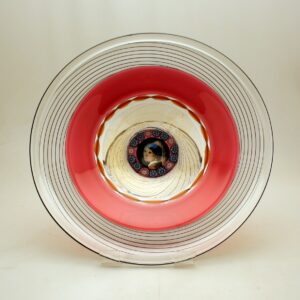
I set a project to make 6 hollow footed bowls and plates with all of the preparation work made while the furnace was off. I was basically proving to myself that the glass melting furnace could be by-passed. I made all the cane work, and flashed glass sections separately, assembling everything over a 3 day period. The project was a success, and those pieces were of a nice size too, around the 9.5-11 inch diameter, and 4.5-5.5 inches in height.
Fast forward to mid July 2022 we turned our glass melting furnace off. For the next 3 years our CO2 e figures from our gas usage are; Mid July 2022-23, 4,156kgs. Mid July 2023-24, 3,722kgs. Mid July 2024-25, 3,307kgs (which includes electricity as well). When it was on 24/7, 365 we created around 98 tons of CO2 every year.
In 2023 we were again shortlisted for a VIBES Award, and even had some people connected with the awards watch a demonstration to verify our claim. They watched me make a Vetro a retortoili tumbler using filigree cane from scratch! First the “fili” cane was pulled, then bundled to make the zanfirico cane then picked-up to make the tumbler. Even a 95% reduction wasn’t good enough to beat those who either brought electric vehicles, led lighting, solar panels or simply off-set against their CO2 emissions. All they said about our 95% reduction in gas usage was, “Twists Glass Studio turned off their furnace and other electrical items”…
So how did we do it? We looked at our workshop and both agreed that the glass melting furnace was the biggest drain on the system. From then, I have spent the past 20 years figuring out ways of working that we didn’t need it on 24/7, 365. Think about it after working for 8 hours that furnace was burning 16 hours of non-productive energy. That a staggering 5,840 hours of wasted energy per year just for the convenience of having a pot of molten glass for the following day…Which has to be worked because you’re burning money as well as energy.
At Twists Glass Studio, apart from our lighting, and the kiln finishing its programme. After we’ve worked, so we have NO WASTED ENERGY, because everything is turned OFF!
And it has some advantages, it’s far more comfortable in the summer, there’s a huge drop in waste glass, a drop in how much colour we use, no use of cullet, so we’re adding to that gradually. I can spend more time with preparation work, and produce art as opposed to production if my last years. There is a downside, it’s bloody freezing in the Winter, even the buckets of water had ice on top, far to cold to go into work on those days!
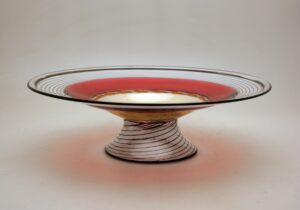

Side view of second bowl featuring Girl with a Pearl Earring with filigree incalmo sections.

Top view of second footed bowl.